
Software Sunsetting, Free Platforms, and the Growing Problem of Digital Dependency
There is a growing concern in the technology industry that deserves considerably more attention than it receives, particularly among businesses and individuals who have spent years building their daily routines, business operations, and digital infrastructure around software platforms they believed would always be available.
It is called software sunsetting, a relatively pleasant term for something that can create significant inconvenience, unexpected expenses, operational disruptions, and, in some cases, the complete loss of functionality that businesses and consumers have come to depend upon.
We live in an era where software is no longer simply something we purchase, install, and own. Increasingly, it is something we subscribe to, access through the internet, or receive free of charge in exchange for becoming part of a company’s growing user base. While these arrangements have made powerful technology more accessible than ever, they have also introduced a fundamental problem that many users do not consider until it is too late.
What happens when the company providing that software decides it no longer wants to support it, changes its business model, or simply disappears altogether?
The answer is rarely as simple as downloading a replacement.
A Recent Reminder: The End of the Arc Browser
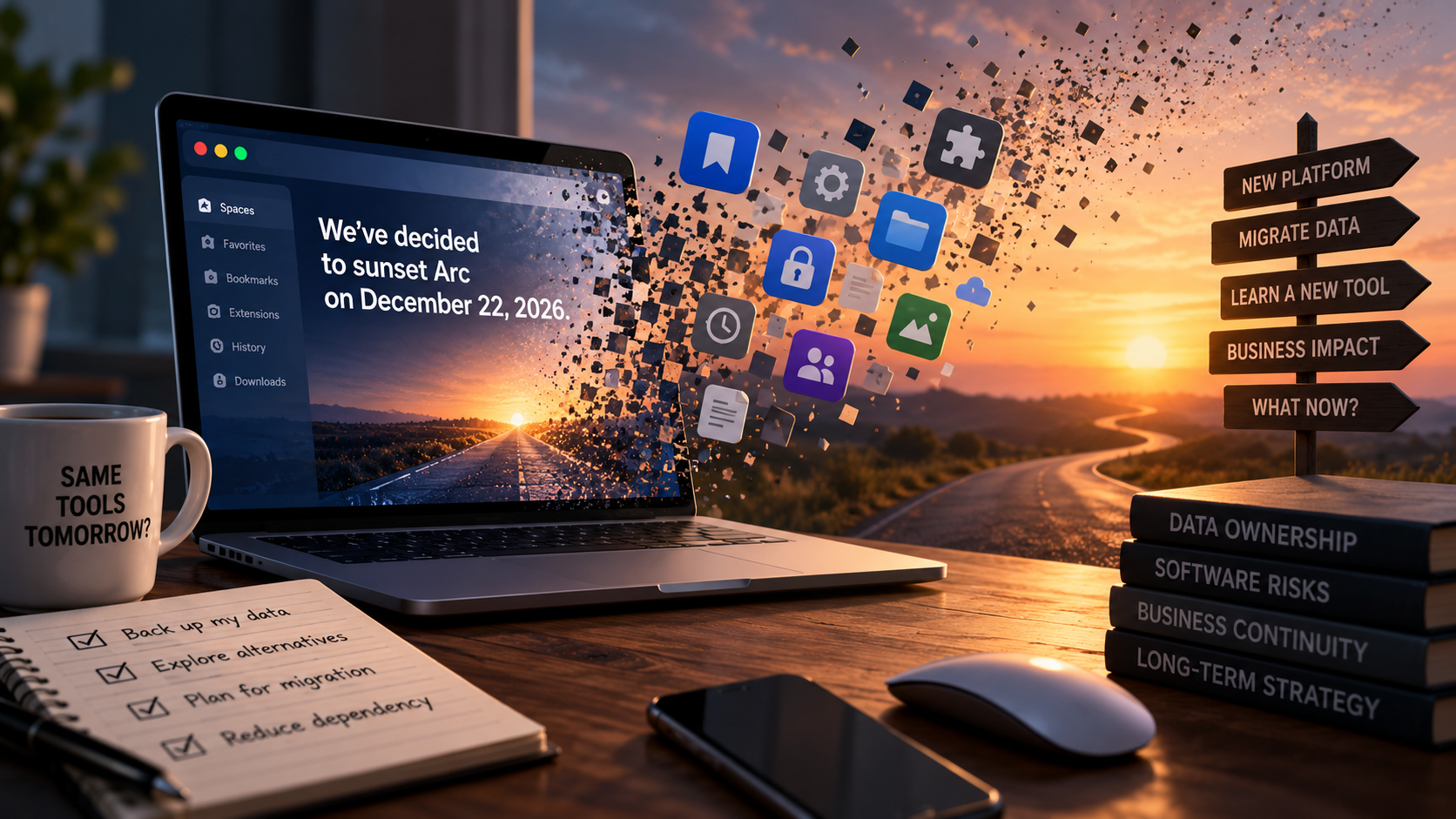
On October 22, 2026, I received an email announcing that the Arc web browser would officially be sunset on December 22, 2026. For those unfamiliar with Arc, it was developed as an alternative to traditional web browsers, introducing a different approach to organizing tabs, managing workspaces, and navigating the internet.
The company spent years developing the browser, attracting users, building a community, and introducing features that distinguished it from more established competitors. Like many software products, Arc became more than an application for some users; it became part of how they organized their work, managed information, and interacted with the internet every day.
According to the announcement, the company is redirecting its engineering and security resources toward Dia, its newer browser designed around modern security requirements and artificial intelligence.
The company explained that maintaining browser security requires continuous engineering resources, particularly as emerging technologies introduce additional complexity. Rather than continuing to support Arc, those resources will now be concentrated on Dia.
To its credit, the company has developed a migration process intended to transfer passwords, bookmarks, browsing history, extensions, folders, spaces, and tab groups into the replacement browser. It also states that familiar Arc functionality remains free in Dia, artificial intelligence features are optional, and the newer platform offers improvements in stability, speed, and security.
From a software development and business perspective, I understand the decision. Maintaining two complex applications requires substantial resources, and concentrating engineering efforts on a single platform may ultimately produce a better product.
However, from the customer’s perspective, the announcement illustrates a much larger issue.
The users who invested their time in Arc did not make the decision to discontinue it, yet they are the ones who must adapt to that decision.
Even with a relatively seamless migration process, the choice to continue using a familiar application has effectively been taken away.
Free Software Is Not Necessarily Without Cost
One of the greatest misconceptions surrounding free software is the belief that because there is no purchase price, there is no financial investment or associated risk.
In reality, free software can become extraordinarily expensive when the time comes to replace it.
Consider a small business that has relied on a free customer management application for five years. During that period, employees have entered thousands of customer records, established procedures around the software, created reports, developed workflows, and trained new employees to use the platform.
Perhaps the software was initially offered free because its developer wanted to attract users, build market share, or establish a foundation for future paid services.
Then one morning, an email arrives announcing that the free version is being discontinued, the company is moving to a subscription model, or the entire platform will shut down within 60 or 90 days.
Suddenly, something that appeared to cost nothing has become a substantial business expense.
The company must evaluate replacement software, determine whether its existing information can be exported, assess compatibility with competing platforms, retrain employees, and potentially hire technical assistance to migrate years of business records.
If the software was integrated with other business systems, those connections may also need to be rebuilt.
The original software may have been free, but the business’s investment in using it certainly was not.
This is where the true cost of software dependency becomes apparent, because the price of replacing an application is frequently measured not in licensing fees, but in lost productivity, employee hours, technical consulting, and operational interruptions.
The Subscription Economy Has Changed the Meaning of Ownership
There was a time when purchasing software meant receiving a physical disk, installing the application on a computer, and continuing to use it for as long as the operating system and hardware supported it.
Software companies might release newer versions, discontinue technical support, or stop selling an older product, but the software itself often continued functioning.
Today, the situation is considerably different.
Many applications require continuous internet connectivity, account authentication, cloud-based databases, and active subscriptions. Even software installed directly on a personal computer may depend on remote servers to validate licenses or provide essential functionality.
When those servers are shut down, the software may stop functioning regardless of whether the customer paid for a perpetual license or invested years in the product.
In effect, consumers and businesses have increasingly transitioned from purchasing software to renting access to technology controlled by someone else.
This distinction becomes especially important when considering applications that manage financial information, business records, photographs, documents, customer communications, and other information that may have significant personal or commercial value.
A company can change its pricing, modify its terms of service, remove features, discontinue integrations, or terminate the product entirely, often with relatively little recourse available to the customer beyond whatever protections exist in the applicable contract.
The customer may own the information entered into the platform, but that does not necessarily mean the customer controls how easily that information can be retrieved or used elsewhere.
Owning your data and having practical access to your data are two very different things.
When a Software Company Disappears Altogether
Sunsetting an application is one thing, particularly when a company provides advance notice and offers a reasonable migration path. A more troubling situation develops when a software company goes out of business, is acquired, or abruptly discontinues its services without providing customers sufficient time to recover their information.
Imagine a business that has used a cloud-based scheduling platform for years, relying on it to manage appointments, customer histories, employee assignments, and automated reminders.
If the company operating that platform closes, the business could lose access to information that is essential to its daily operations.
The problem becomes even more complicated when the application uses a proprietary database structure or stores information in a format that competing software cannot easily import.
Even when customers receive an export of their information, that export may contain little more than raw data, leaving behind the relationships, formatting, attachments, workflows, and customizations that made the original software useful.
The business may technically have its records, but rebuilding a functional system around those records can become a separate and expensive development project.
Acquisitions present another concern, as companies sometimes purchase competing platforms primarily for their customers, intellectual property, or technology, rather than because they intend to maintain the acquired software indefinitely.
A product that was once affordable, innovative, and independently operated can become part of a much larger corporate strategy in which the original customer experience is no longer a priority.
None of these scenarios necessarily involve misconduct by the software developer. Companies have legitimate financial, technical, and competitive reasons for changing direction, but those decisions can nevertheless create substantial consequences for customers who have become dependent on their products.
Artificial Intelligence Is Accelerating the Software Lifecycle
Artificial intelligence is introducing another dimension to an already complicated software marketplace.
Developers can now create, test, modify, and deploy software at speeds that would have been difficult to imagine only a few years ago. Features that once required months of development can sometimes be prototyped in days, while entirely new applications can emerge before established competitors have completed their next major release.
This acceleration is creating tremendous opportunities, but it is also placing additional pressure on software companies to innovate, consolidate products, and reconsider whether older platforms remain financially viable.
The Arc announcement provides an interesting example of this transition, with the company choosing to concentrate its resources on a newer browser rather than continuing to maintain its previous product.
We should expect to see more of these decisions as artificial intelligence becomes increasingly integrated into browsers, productivity applications, customer management systems, accounting software, and virtually every other category of digital technology.
However, there is another side to this development that deserves consideration.
Just because software can be developed faster does not mean it should be replaced more frequently, particularly when customers have established years of operational dependency around an existing product.
Innovation is important, but so are continuity, reliability, and the preservation of a customer’s investment in technology.
A newer application may offer impressive capabilities, but those improvements mean considerably less to a business if adopting them requires abandoning established workflows or rebuilding systems that were functioning perfectly well.
The Hidden Danger of Building Your Business Around Someone Else’s Platform
As a web developer, I regularly work with businesses that rely on a combination of websites, custom applications, third-party services, hosting providers, payment processors, communication systems, and other technologies to conduct their daily operations.
Each of these services introduces a dependency, and every dependency represents a potential point of failure if the provider changes its policies, increases pricing, discontinues functionality, or ceases operations.
This does not mean businesses should avoid third-party software, because doing so would be impractical and unnecessarily expensive. It does mean that businesses should understand what they are depending upon and what would happen if one of those services became unavailable.
For example, a company may spend years developing its website around a proprietary website builder, only to discover that moving to another hosting provider requires rebuilding much of the site because the underlying platform cannot be transferred.
Another business may rely on a cloud-based form application to collect customer inquiries, service requests, or important documents, without realizing that its historical submissions are stored exclusively within the provider’s infrastructure.
A third company may integrate several subscription services into its daily operations, creating a complicated network of dependencies in which the failure or discontinuation of one service affects several others.
These arrangements can work extremely well for years, which is precisely why the risks are often overlooked.
The greatest danger is not necessarily that a software platform will disappear tomorrow, but that a business may have no practical plan for operating without it.
Why I Favor Software That Businesses Can Control
My approach to software development has increasingly emphasized ownership, portability, and reducing unnecessary dependence on third-party platforms.
When practical, I prefer building functionality directly into an existing WordPress website or developing a dedicated PHP application rather than introducing another monthly subscription for a service that performs a relatively straightforward business function.
This approach is not appropriate for every situation, and there are certainly excellent subscription-based applications that provide capabilities that would be prohibitively expensive to develop independently.
However, when a business can maintain greater control over its software, databases, hosting environment, and source code, it generally has more options if a service provider changes direction.
A properly developed WordPress website, for example, can often be moved between hosting providers without requiring the business to rebuild its entire online presence. Similarly, a custom PHP application built using documented, widely supported technologies can offer greater flexibility than a system whose essential functionality depends entirely on a proprietary third-party service.
Of course, custom software is not automatically immune to obsolescence, security vulnerabilities, or maintenance costs. WordPress plugins can be abandoned, programming languages evolve, hosting requirements change, and even open-source projects can lose the developers who maintain them.
The distinction is that businesses with access to their source code, databases, documentation, and appropriate technical resources may have the opportunity to maintain, modify, or migrate their systems without waiting for the original software vendor to provide a solution.
In my opinion, that flexibility has considerable long-term value.
Open Source Offers Advantages, but It Is Not a Guarantee
Open-source software is frequently presented as a solution to vendor dependency, and in many respects it offers meaningful advantages over closed, proprietary platforms.
When source code is publicly available under a license that permits modification and continued use, developers may be able to maintain software even after its original creator stops supporting it.
That can provide an important level of independence, particularly for businesses with the technical resources to manage their own applications.
However, open source should not be confused with maintenance-free software.
An abandoned open-source application can become a security liability if vulnerabilities are discovered and no one is available to correct them. Compatibility problems may emerge as operating systems, databases, and programming languages evolve, and finding qualified developers to maintain an obscure application may become difficult or expensive.
The real advantage is not that open-source software will last forever, but that its users may have more opportunities to extend its useful life or transition away from it on their own terms.
That is a significant distinction in a technology marketplace where access to proprietary software can disappear with little more than an email announcement.
What Businesses and Consumers Should Be Asking Before Adopting Software
The decision to adopt a new software platform should involve more than comparing features, reviewing customer ratings, or determining whether the monthly subscription fits within the budget.
Businesses should also consider how easily their information can be exported, whether the software relies on proprietary formats, what happens if the subscription is canceled, and whether another provider could reasonably replace the application without substantial disruption.
They should understand whether the platform stores critical information locally or exclusively in the cloud, whether backups are available in usable formats, and whether the company has a documented policy for discontinuing services.
For business-critical applications, it is also worth considering whether a vendor offers contractual commitments regarding data retention, advance termination notices, and assistance with migrating information.
These questions may seem excessive when evaluating a simple application, but their importance increases considerably when software becomes part of a company’s financial management, customer relationships, inventory, communications, or daily operations.
For consumers, similar concerns apply to applications that manage personal photographs, passwords, family records, purchased digital content, and other information that may be difficult or impossible to replace.
Perhaps most importantly, users should periodically verify that their information can actually be recovered and opened outside the original application.
A backup that cannot be restored, or an export that cannot be meaningfully imported into another system, provides considerably less protection than many people assume.
The Real Cost of Migration Is Often Overlooked
Software companies frequently describe migration as a relatively simple process, emphasizing the ability to transfer data, import settings, and continue working in a replacement application.
In some cases, that process is genuinely straightforward, and Arc’s planned transition to Dia appears designed to minimize many of the common frustrations associated with changing browsers.
However, transferring information is only one component of a successful migration.
Users must often learn a different interface, adjust established habits, recreate custom configurations, verify integrations, and determine whether familiar features behave as expected.
For a single individual, those changes may amount to several hours of inconvenience. For a business with dozens of employees, the cumulative expense can become substantial.
There is also an important distinction between replacing a general-purpose application and replacing specialized software that has been customized around a company’s particular operations.
A business may discover that its replacement platform offers more features overall while lacking one or two essential functions that made the previous application valuable.
Those missing capabilities can require additional subscriptions, custom programming, or changes to established business procedures.
Consequently, the actual cost of migrating software should include not only the price of the replacement application, but also the time, labor, training, technical assistance, and potential operational disruptions associated with the transition.
Software Companies Have Responsibilities, Too
I recognize that software developers and technology companies cannot reasonably be expected to support every product indefinitely.
Security requirements change, operating systems evolve, market conditions shift, and maintaining outdated applications can become financially unsustainable.
There are legitimate reasons to retire software, particularly when continued operation would expose customers to security risks that can no longer be responsibly managed.
However, I also believe software companies have a responsibility to recognize the investments their customers have made in adopting their products.
When a company encourages users to integrate its software into their daily lives or business operations, it should anticipate that discontinuing the product may have consequences beyond the loss of a convenient application.
Reasonable advance notice, accessible data exports, clear migration instructions, and transparent communication should be fundamental parts of any responsible software retirement strategy.
Where practical, companies should also consider whether customers can continue using a limited offline version, obtain access to their records after shutdown, or transition to an alternative platform without losing essential information.
The Arc announcement demonstrates some of these considerations by providing a specific retirement date, explaining the reasoning behind the decision, and offering a migration path to another product developed by the same team.
That is preferable to an abrupt shutdown, but it does not eliminate the larger concern surrounding customer dependency on software they do not control.
Nothing in Technology Is Permanent
The internet has created an extraordinary environment in which individuals and businesses can access powerful tools, sophisticated applications, and services that once would have required enormous financial investments.
At the same time, it has encouraged us to place increasing amounts of our information, productivity, and business infrastructure into systems operated by companies whose future decisions we cannot control.
We tend to assume that established software will continue operating because it has always been there, particularly when it has become deeply integrated into our daily routines.
Yet the history of technology is filled with applications, platforms, online services, and entire companies that were once considered essential and are now little more than memories.
Some disappeared because better technology emerged, others failed financially, and still others were discontinued because their owners decided that resources would be more profitably invested elsewhere.
Artificial intelligence will almost certainly accelerate this cycle as software companies compete to introduce new capabilities, replace older products, and redefine how people interact with technology.
That evolution is inevitable, but it should also encourage businesses and consumers to become more deliberate about the technologies they adopt.
Convenience should never be mistaken for permanence, and popularity should never be confused with long-term reliability.
For businesses in particular, maintaining control over critical information, understanding software dependencies, and establishing practical alternatives should be considered part of responsible technology management rather than an unnecessary expense.
As developers, we also have a responsibility to help clients understand these risks and recommend solutions that balance innovation with stability, portability, security, and long-term value.
The announcement that Arc will be discontinued on December 22, 2026, is not necessarily a story about a software company making the wrong decision. It is a reminder that even thoughtfully developed, widely appreciated applications can reach the end of their commercial lives while their customers still find them useful.
And that brings us back to the question every business owner and software user should occasionally ask:
If the software you depend upon today disappeared tomorrow, how much of your business, your information, or your daily routine would disappear with it?
If you cannot answer that question with reasonable confidence, it may be time to reconsider just how much control you actually have over your digital world.
Shon Sullivan
3GEES Media | Web Development & Custom Software Solutions
Related Posts