

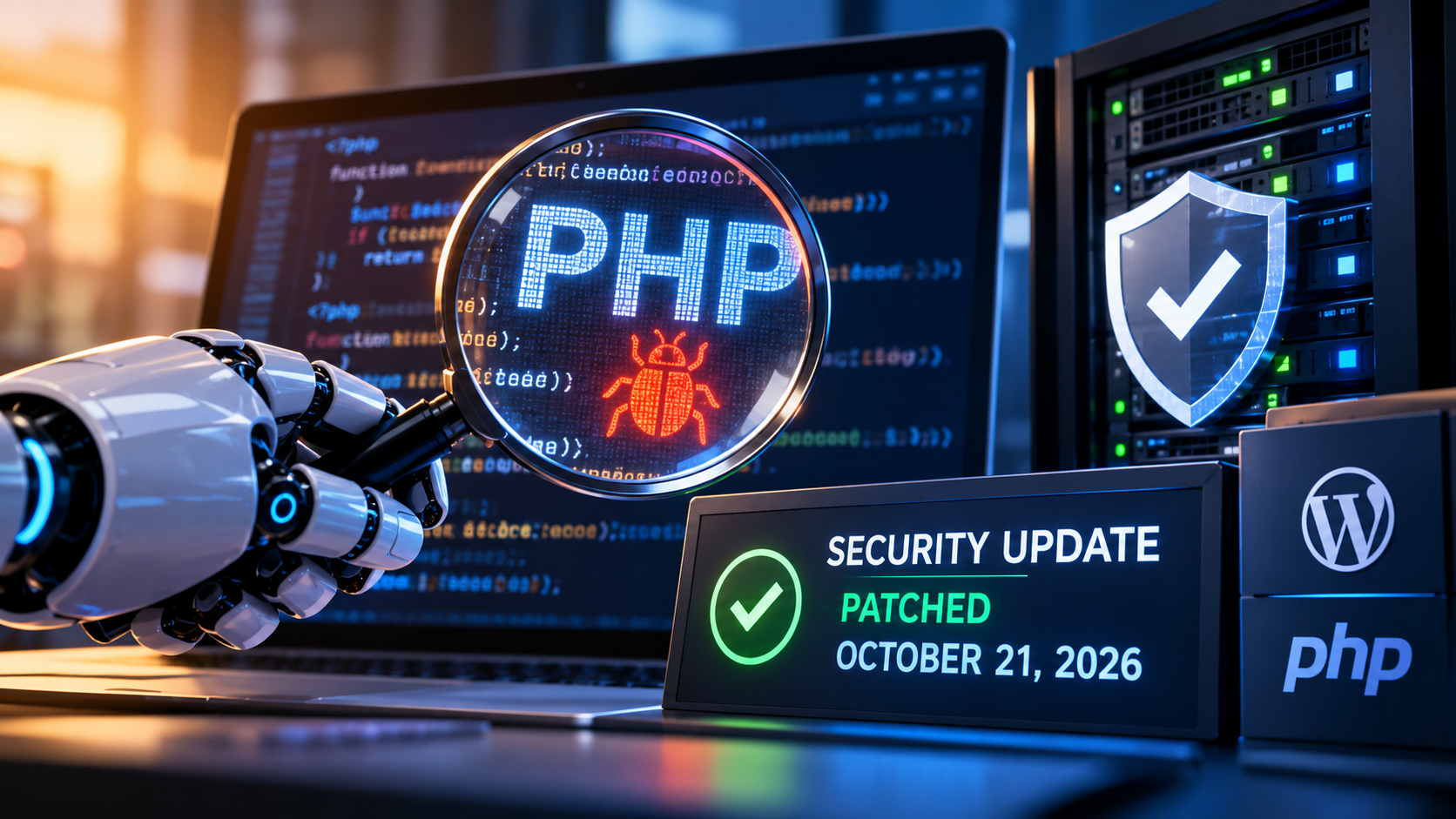
A significant security discovery involving PHP serves as another reminder that even the most established technologies powering the internet are not immune to vulnerabilities, and artificial intelligence is changing how quickly those weaknesses can be discovered.
On October 21, 2026, emergency security updates were released for PHP, one of the most widely used programming languages powering websites and web applications around the world. The updates addressed serious security vulnerabilities, including an issue reportedly dating back more than a decade that was uncovered through the use of artificial intelligence working alongside a security researcher.
For those unfamiliar with PHP, it is the underlying programming technology responsible for operating millions of websites, including WordPress and countless custom-built web applications. With PHP used by more than 70% of websites whose server-side programming language is known, a vulnerability within its core software deserves immediate attention from hosting providers, developers, and security professionals.
The discovery is significant not only because of the potential security exposure, but because of how it was discovered and what it tells us about the future of internet security.
Our Clients’ Websites and Applications Have Been Updated
First, I want to assure our clients that the hosting environments supporting the PHP applications and WordPress websites we manage were patched on October 21, 2026.
Following the security announcement, we worked with the appropriate hosting providers to ensure the necessary PHP updates were applied. We also visually inspected and confirmed the updated PHP versions within the hosting environments rather than simply relying on notifications that the updates had been completed.
It is important to understand that this vulnerability was not discovered within our clients’ websites, their WordPress installations, or the custom PHP applications we have developed. The issue involved the underlying PHP runtime provided by the hosting infrastructure, which processes and executes the PHP code these websites and applications depend upon.
Think of it as a security flaw discovered within an operating system rather than within an individual application running on that system. Correcting the underlying software protects the environment without necessarily requiring changes to the applications themselves.
While confirming that the appropriate updates have been installed does not guarantee that any website is completely free from security vulnerabilities, it does confirm that the hosting environments have received the applicable PHP security patches.
A Decade-Old Vulnerability Discovered With Artificial Intelligence
Perhaps the most interesting aspect of this discovery is the role artificial intelligence played in identifying a security weakness that reportedly existed for more than ten years.
For perspective, consider the enormous number of software engineers, security professionals, hosting companies, and developers who have worked with PHP during that period. PHP has undergone countless updates, security reviews, performance improvements, and revisions, yet vulnerabilities can remain hidden within its underlying code for years.
The reported discovery involved a security researcher using artificial intelligence to examine software behavior and identify weaknesses that traditional reviews had not previously uncovered. Work of this complexity could potentially require a team of experienced software engineers ten weeks or longer to investigate, depending on the scope and methodology involved.
That comparison is an illustration of the potential efficiency of AI-assisted security research, rather than a verified measurement of how long this particular discovery would have taken without AI.
What makes this especially compelling is the possibility that, without artificial intelligence, the vulnerability might have remained undiscovered for years to come, perhaps indefinitely.
We are witnessing a fundamental change in how software is developed, reviewed, tested, and secured. Artificial intelligence is becoming more than a tool for writing code or automating routine tasks. It is increasingly capable of helping researchers identify complex relationships, unusual behavior, and potential security weaknesses buried deep within software that has been in production for decades.
This discovery illustrates just how valuable that capability may become.
The Uncomfortable Reality of Internet Security
There is another side to this story that deserves attention.
If artificial intelligence working alongside one researcher can uncover a serious vulnerability within technology that has been used worldwide for more than a decade, we should reasonably expect that additional vulnerabilities remain undiscovered.
I would not expect this to be the last significant security issue AI helps identify within PHP, WordPress, other content management systems, or the countless software components supporting today’s internet.
The internet is a fluid, constantly evolving ecosystem. Software is continually updated, technologies are interconnected, new features are introduced, and millions of servers exchange information every second. While this enormous infrastructure works remarkably well, it is far from perfect.
Every layer introduces potential weaknesses, whether those weaknesses originate in programming languages, server configurations, databases, third-party libraries, plugins, or the applications themselves.
There is also a troubling reality that should not be overlooked. Not every vulnerability is discovered first by a responsible security researcher.
Malicious hackers, often referred to as bad actors, actively search for weaknesses they can exploit for financial gain, unauthorized access, data theft, and other criminal activities. Some vulnerabilities are discovered and exploited long before software developers or security researchers become aware of their existence.
These are commonly referred to as zero-day vulnerabilities, and they represent some of the more difficult challenges facing cybersecurity professionals because a software manufacturer may have no knowledge of the problem when exploitation begins.
We should not assume that every vulnerability has already been identified, or that the absence of a reported security problem means a particular system is completely secure.
No website, server, application, or software platform can honestly be described as 100% secure.
That is not intended to alarm anyone. It is simply the reality of operating technology connected to a worldwide network.
Artificial Intelligence Is Changing Both Sides of Cybersecurity
I believe discoveries like this represent an important turning point in software security.
For years, vulnerability research has depended heavily on specialized engineers manually reviewing code, performing security audits, testing unusual conditions, and examining how applications behave under different circumstances.
Artificial intelligence can now assist with portions of that work at a speed and scale that would have been difficult to imagine only a few years ago.
This is encouraging for responsible developers and security researchers because it creates opportunities to identify weaknesses before they are exploited. However, the same technology that helps researchers discover vulnerabilities can also be used by malicious individuals attempting to find and exploit those weaknesses.
AI does not eliminate the security problem. In many respects, it changes the speed at which both sides can operate.
As AI-assisted security research becomes more sophisticated, I expect we will see more discoveries involving longstanding software vulnerabilities, including weaknesses in technologies that have been trusted and widely deployed for many years.
Some of these discoveries will lead to emergency patches, while others may require substantial changes to existing software architectures and security practices.
The important distinction is how quickly vulnerabilities are responsibly disclosed, corrected, distributed, and ultimately installed within the environments where that software operates.
Security Does Not End With the Website Developer
One misconception I frequently encounter is the assumption that website security begins and ends with the website itself.
In reality, a website or web application depends upon multiple layers of technology, and responsibility for maintaining those layers is shared among developers, hosting providers, software vendors, and website owners.
A WordPress website, for example, relies on WordPress core software, installed plugins and themes, a database, PHP, web server software, and the hosting environment. A custom PHP application may eliminate the dependency on WordPress and its plugin ecosystem, but it still relies on the underlying PHP runtime, database, operating system, and hosting infrastructure.
A security vulnerability discovered in any one of those components can potentially affect the overall environment.
This is why working with responsible hosting providers is important. A developer can maintain secure application code, implement appropriate safeguards, and monitor for suspicious activity, but server-level vulnerabilities often require intervention from the company managing the hosting infrastructure.
The October 21 emergency PHP updates are a good example of that shared responsibility. The appropriate correction was to update the affected PHP software at the hosting level, followed by verification that the corrected versions were installed and functioning properly.
Our Approach to Monitoring Security Threats
At 3GEES Media, we recognize that maintaining websites and custom applications requires more than developing features, updating content, and keeping everything operational.
We consistently review technology periodicals, software security announcements, industry reporting services, vulnerability disclosures, and reports involving malicious online activity. This ongoing research helps us stay informed about emerging threats, software defects, newly discovered exploits, and changes affecting the technologies we use.
We also recognize that security is not a one-time project or a setting that can simply be enabled and forgotten.
The technology supporting the internet changes constantly, and our approach to maintaining websites and applications must evolve along with it. That includes keeping informed about new vulnerabilities, communicating with hosting providers, verifying important updates, and evaluating how emerging technologies may affect the applications we develop and maintain.
We cannot reasonably promise that vulnerabilities will never be discovered or that a particular website will never be targeted. What we can do is remain informed, respond responsibly to known threats, and take appropriate action when security updates become available.
That commitment is particularly important as artificial intelligence accelerates both software development and vulnerability discovery.
A Final Thought: The Internet Is Never Finished
After years of developing and maintaining websites and web applications, one thing remains abundantly clear to me: the internet is never a finished product.
It is an enormous collection of interconnected technologies built and maintained by people, and people make mistakes. Some mistakes are discovered immediately, while others remain hidden for years, even decades.
What happened with PHP on October 21, 2026, is a reminder of that reality, but it is also an encouraging example of how new technologies can help us uncover and correct problems that might otherwise remain undetected.
Artificial intelligence is going to play an increasingly important role in this process. It will help developers write better code, assist researchers in identifying vulnerabilities, and give security professionals additional tools to protect the systems we depend upon every day.
At the same time, it will introduce new challenges, and we should expect more discoveries like this in the years ahead.
For our clients, the immediate concern has been addressed through the installation and visual verification of the appropriate PHP security updates within their hosting environments.
For the broader internet, however, the lesson is much larger. We should never confuse a system that is operating correctly today with a system that is guaranteed to be secure tomorrow.
Security is an ongoing responsibility, not a permanent condition.
And if one researcher working with artificial intelligence can help uncover a vulnerability that remained hidden for more than a decade, imagine what we may discover next.
— Shon Sullivan, 3GEES Media
Related Posts