
For more than two decades, the internet operated on a relatively simple exchange. Publishers, bloggers, journalists, businesses, and content creators produced information. Search engines, led primarily by Google, indexed that information and directed users to the websites that created it. In return, those websites earned advertising revenue, sold products and services, generated leads, or built audiences through the traffic they received.
This arrangement fueled the explosive growth of the modern internet.
By the early 2020s, many digital publishers and content-driven businesses received as much as 75% or more of their website traffic from Google Search. Entire industries were built around search engine optimization (SEO), content marketing, affiliate publishing, online journalism, blogging, and educational resources. Search engines acted as gateways, connecting users to the websites that produced the information.
Today, that model is rapidly changing.
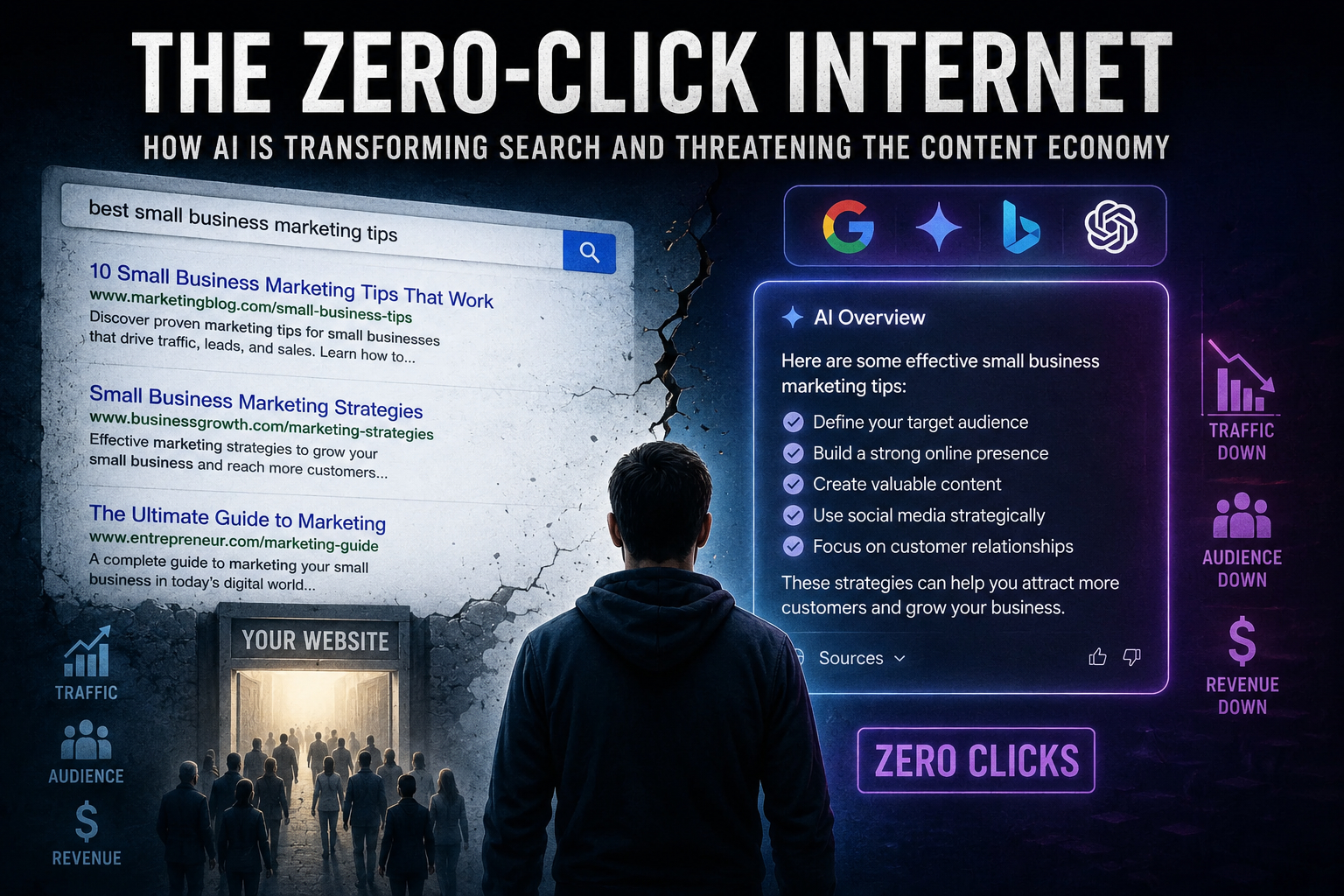
The rise of artificial intelligence, combined with evolving search technologies, has created what is increasingly being called the “Zero-Click Internet”—an online environment where users receive answers directly from platforms without ever visiting the original source of information.
The Evolution from Search Engine to Answer Engine
Historically, search engines presented a list of links. Users entered a question, reviewed search results, and clicked through to websites that contained the information they sought.
The process benefited everyone involved:
- Users found information.
- Search engines provided discovery.
- Publishers received visitors.
- Businesses earned revenue from their content.
Artificial intelligence has fundamentally altered this relationship.
Today, Google, Microsoft Bing, Yahoo Search, ChatGPT, Perplexity, and numerous AI-powered platforms increasingly provide complete answers directly within search results. Instead of offering links to ten websites, they often summarize information, generate explanations, answer questions, create lists, and provide recommendations without requiring the user to leave the platform.
For the user, this experience is undeniably convenient. Answers arrive faster and require less effort.
For the content creators who originally produced the information, however, the consequences are significant.
The Decline of Referral Traffic
Across many industries, publishers are reporting substantial declines in organic search traffic.
Where a website may have previously received thousands of daily visitors from search engines, many now find users consuming summarized versions of their content directly within AI-generated search results.
The result is fewer website visits, fewer page views, fewer advertising impressions, and fewer opportunities to convert readers into customers.
The challenge is not merely that users are choosing different websites. The challenge is that users are increasingly choosing not to visit websites at all.
This represents one of the most significant disruptions to the digital publishing industry since the birth of the commercial internet.
The Rise of Zero-Click Searches
A zero-click search occurs when a user performs a search but never clicks on a website.
Examples include:
- Weather forecasts displayed directly in search results.
- Sports scores shown without visiting a news site.
- Business hours presented instantly.
- AI-generated summaries of articles.
- Product comparisons generated by artificial intelligence.
- Direct answers to questions that once required reading multiple websites.
As AI systems become more sophisticated, the number of searches resulting in no website visit continues to grow.
The internet is moving from a model of exploration toward a model of extraction, where information is gathered from millions of websites but consumed primarily through centralized platforms.
The Economic Impact on Content Creation
The greatest concern may not be technological but economic.
Creating quality content requires investment.
Journalists conduct research and interviews.
Industry experts write educational articles.
Businesses publish resources for customers.
Independent creators produce tutorials, videos, podcasts, and specialized content.
All of these activities require time, labor, expertise, and money.
For twenty years, website traffic served as the economic engine that funded this work. Advertising revenue, sponsorships, subscriptions, memberships, and lead generation justified the cost of content production.
If traffic disappears, the financial incentive to create that content weakens.
A business owner who once generated customers through educational articles may stop publishing them. A publisher who loses advertising revenue may reduce reporting staff. Independent creators may abandon niche topics that no longer generate sustainable returns.
The danger is not simply fewer websites.
The danger is fewer humans creating original information.
The Human Knowledge Problem
Artificial intelligence does not create knowledge in the traditional sense.
AI systems synthesize, summarize, and reorganize information that already exists.
They learn from articles, books, research papers, reports, forums, videos, and countless forms of human-generated content.
If the creation of original content becomes economically unsustainable, the supply of new information may decline.
This creates a long-term paradox.
AI systems require a constant flow of fresh human-created knowledge to remain useful.
Yet the widespread adoption of AI-generated answers may undermine the very economic ecosystem that produces that knowledge.
In other words, AI may be consuming the resources required for its own future development.
Small Businesses Face New Challenges
Large technology companies possess the resources to adapt to changing digital landscapes.
Small businesses often do not.
For years, content marketing provided smaller organizations with a cost-effective way to compete. A local accounting firm, law office, contractor, consultant, or retailer could publish useful content and attract customers through search.
Many businesses invested heavily in blogs, educational resources, videos, podcasts, and social media because organic search traffic offered measurable returns.
As referral traffic declines, those investments become harder to justify.
Businesses that spent years building digital assets may find themselves increasingly dependent on paid advertising or platform-controlled visibility.
The result is greater concentration of power among the largest technology platforms.
The Future of Journalism and Independent Publishing
Perhaps no industry faces greater uncertainty than journalism.
News organizations already operate within challenging economic conditions. AI-generated summaries and answer engines threaten to further reduce direct readership and subscription opportunities.
Independent publishers face similar concerns.
Niche experts who built audiences through search traffic may discover that AI platforms answer many user questions before visitors ever reach their websites.
Without sustainable revenue, fewer voices may participate in creating specialized, expert-driven content.
The diversity of information available online could suffer as a result.
Can the Content Economy Adapt?
History suggests that industries adapt to technological disruption, but adaptation often takes time.
Several possible outcomes may emerge:
Publishers may place more content behind paywalls.
Businesses may shift toward direct audience ownership through email newsletters and memberships.
Content creators may increasingly focus on video, podcasts, live events, and community building.
Licensing agreements between AI companies and publishers may become more common.
New compensation models may emerge that reward original content creators whose work contributes to AI-generated responses.
The challenge is that none of these solutions currently replace the scale and predictability of search-driven traffic that powered much of the internet for the last twenty years.
The Road Ahead
The Zero-Click Internet represents more than a technological evolution. It is a fundamental restructuring of the relationship between users, platforms, and content creators.
Artificial intelligence has made information more accessible than ever before. Users can obtain answers in seconds without navigating multiple websites or reading lengthy articles.
Yet convenience carries consequences.
The modern internet was built by millions of businesses, journalists, educators, researchers, hobbyists, experts, and creators who invested their time and resources into producing knowledge. If those creators can no longer sustain themselves economically, the volume and quality of original content may decline.
The irony is difficult to ignore. The same technologies that make information easier to consume may ultimately reduce the incentive to create it.
Whether the internet evolves into a sustainable balance between AI-driven answers and human-created content remains uncertain. What is certain is that the content economy that defined the internet from 2000 through 2020 is undergoing one of the most significant transformations in its history.
The future of the web may depend on finding a way to ensure that those who create knowledge continue to be rewarded for producing it.
Related Posts