

How to Choose the Right Website for Your Business Needs
Advice from a Web Developer with 30 Years of Experience
My name is Shon Sullivan, and for more than three decades I have helped individuals, entrepreneurs, and small local businesses build and maintain their online presence. While the tools used to create websites have changed dramatically over the years, the core principles of good design, strong branding, and effective marketing have remained the same. I started in the early days of web development, when every site was hand-coded from scratch and today’s drag-and-drop builders did not exist. Because the barrier to entry was much higher, the digital world was far less crowded than it is today.
Over the years, I have seen platforms come and go, trends rise and fall, and competition become more intense as technology made it easier for anyone to build a website. However, simply having access to the tools does not replace experience. My focus has always been on helping small and local businesses create websites that are built correctly, built to last, and designed with real marketing strategy behind them — not just something that looks good today, but something that continues to work for years to come.
Today I use WordPress, modern frameworks, and visual builders when appropriate, along with custom coding when branding or functionality requires it. The technology evolves, but the decision process business owners go through has not changed at all.
When a business owner asks me, “What kind of website do I need?”, the answer is almost never simple. After nearly 30 years building websites for small local businesses — including accountants, contractors, non-profits, legal firms, and service companies — I can tell you that most people start the process with the wrong idea of what they actually need.
And the same mistakes keep happening over and over again.
Most Businesses Want the Wrong Thing at the Start
When someone says they need a website, what they usually mean is they saw another website and want something similar. That is one of the biggest problems right from the beginning.
I see clients who want something far more complex than they actually need. Others want something as cheap as possible and don’t realize they are creating a problem they will have to fix later. Some think they need e-commerce when they don’t even sell products online. Others copy competitors without understanding why those features exist in the first place.
A website should match your business, not someone else’s.
You should build for where your business is today, while allowing room to grow later. When you try to build everything at once, you usually end up with something expensive, confusing, or difficult to maintain.
Real-World Examples of Choosing the Wrong Platform
A large percentage of rebuild projects I get come from businesses that started with the wrong platform.
I have worked with many clients who first used Wix, Squarespace, or GoDaddy because they were told it would be cheap and easy. In the beginning, those systems seem fine. But later they run into problems with performance, limitations, security, or simply not knowing how to organize their content in a way that actually sells their service.
In some cases, the business didn’t even know what content they needed to have on the site in the first place. They had pages, but no real message. They had a design, but no marketing structure. They had a website, but it wasn’t doing anything for the business.
Other times the issue was maintenance and security. A site gets built, but nobody plans for updates, backups, or monitoring. Eventually something breaks, or worse, the site gets hacked. Then the cost to fix it is more than the cost to build it correctly in the first place.
These situations are very common, and most of them could have been avoided with better planning at the start.
My Honest Opinion on Website Platforms
After working in this industry for 30 years, I have strong opinions about platforms. Not because of marketing, but because I have seen what works and what fails over time.
WordPress
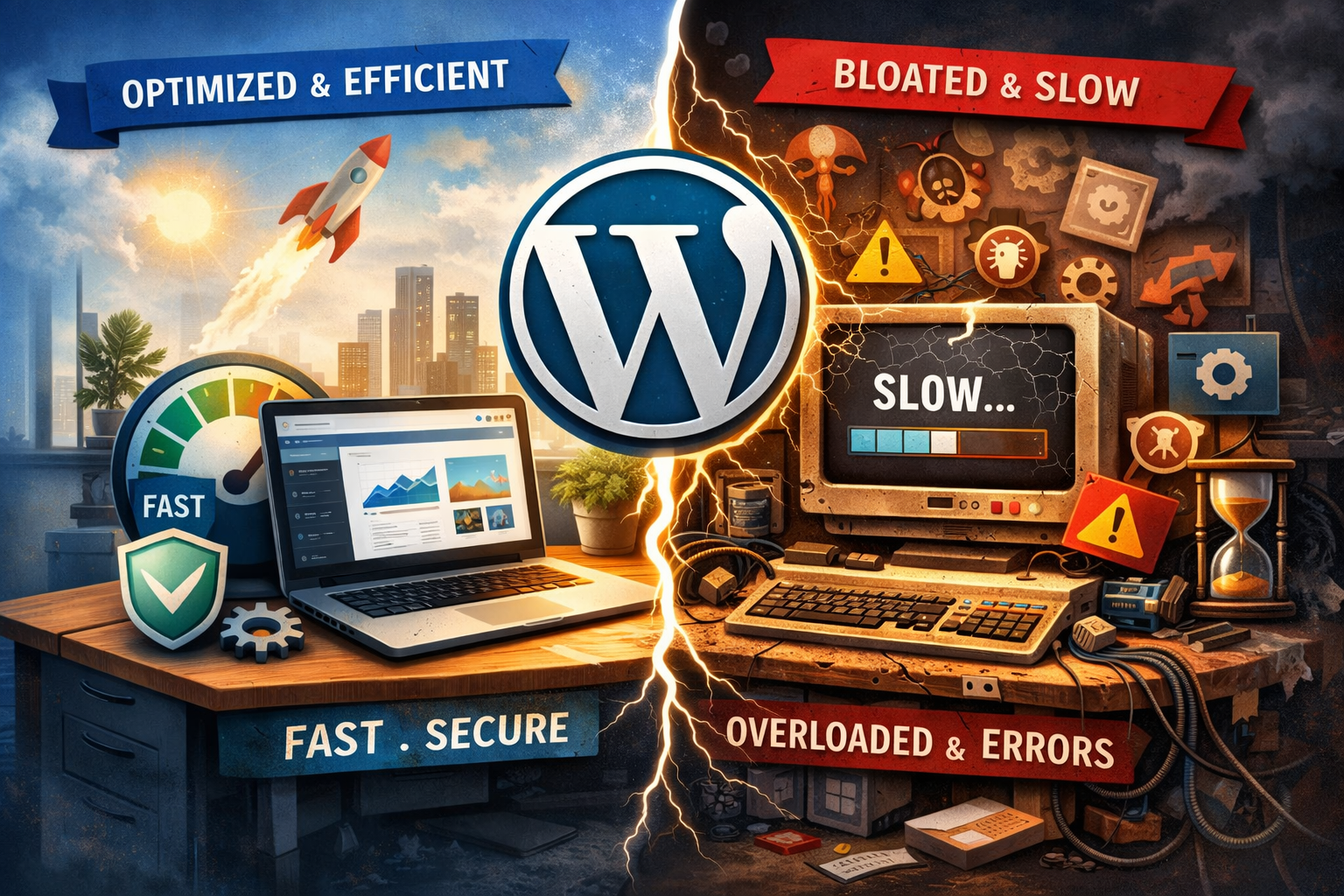
WordPress is still one of the best platforms available for small businesses when it is set up correctly. It is powerful, flexible, and can grow with your company. However, in recent years it has become bloated with too many enhancements, plugins, and add-ons. When used properly it is top-of-the-line. When used incorrectly, it becomes slow, messy, and difficult to maintain.
Wix and Squarespace
These are good beginner platforms and can work well for very small businesses that simply need an online presence. The problem is that once you are inside those systems, it can be very hard to leave. If your business grows or you need more control, moving to another platform often means starting over from scratch. I often tell clients that it is easy to get into these systems, but not always easy to get out. In many ways, it is like divorcing your platform.
When you use systems like Wix or Squarespace and your website begins collecting data—such as customer information, emails, phone numbers, invoices, receipts, or other records—that data becomes integrated into their ecosystem. At that point, you are not only committed to the platform, but your data is as well. If you decide to move, the process can be as complicated as a divorce. Some platforms make it difficult to keep your data, and others provide limited or no export tools at all. In some cases, once the system detects that you are planning to leave, you may suddenly be offered incentives to stay.
If you have ever tried to cancel cable TV service, you already know what to expect. The same thing can happen with closed website platforms, where the business model depends on keeping you as a monthly subscriber for as long as possible.
GoDaddy
GoDaddy was once known for inexpensive hosting, but that is no longer really the case. Over the years, they have added too many extra tools, too many upsells, and their hosting performance is not what it used to be. For most small businesses, there are better hosting options available today that cost the same—or even less—and provide much better reliability and speed.
In fact, if you speak with almost any SEO professional, one of the first things they look at is your hosting provider. Hosting plays a major role in website performance. Companies like GoDaddy, and many others that rely heavily on shared hosting, often rank near the bottom when it comes to speed and consistency. Slow servers, overcrowded shared environments, and inconsistent response times can negatively affect your page speed, search engine rankings, and overall SEO performance.
Low-cost Overseas Developers
This is another situation I see often. A business hires a very low-cost overseas developer and ends up stuck in a cycle of paying for fixes, waiting for replies, or being told more money is needed to finish the job. I understand the appeal—the hourly rate can be a fraction of what you would pay in the United States, and it looks like you are getting more for your money. The reality, however, is that overseas talent can be hit-or-miss if you do not know exactly what to look for. Projects sometimes drag on, work may not be completed correctly, and in some cases the business does not even have full control over their own website. Time zone differences, language barriers, and misunderstandings can make small problems much bigger.
Hiring locally is not perfect either, but when problems happen you usually have clearer communication and better recourse to get things resolved. When you add distance, different laws, and limited accountability, you can end up compounding the problem. Saving money up front may sound good, but if the project goes wrong and there is no practical way to fix it, the cost can end up far higher than expected.
DIY vs Hiring a Professional
Many business owners try to build their own website to save money, only to realize later that the time spent learning the tools, fixing mistakes, and trying to optimize the site could have been better spent running their business. A professional designer not only builds the site correctly the first time, but also understands marketing, branding, search engine optimization, and long-term scalability. If you are considering working with an experienced developer, you can review my professional website design and development services to see what options are available.
What Business Owners Should Focus on First

When I sit down with a client, I tell them the same thing every time. Before you choose a platform, you need to think about the bigger picture.
You need to consider your budget, but also the long-term cost.
You need to think about marketing, not just having a website.
You need to plan for SEO, content, and branding.
You need to understand maintenance and security.
You need to make sure you actually own your website.
You need to plan for growth without overbuilding at the start.
And most importantly, you need to choose the right person to build it.
Most bad website decisions happen because someone only focuses on one of these things, usually the price.
A website is not an expense you try to minimize.
It is a business tool you want to build correctly.
Final Thoughts After 30 Years in This Business
In 30 years of building websites, I have seen the tools change many times. I went from hand-coding everything to using modern platforms like WordPress and visual builders. The technology is different, but the decision process business owners go through is still the same.
The right website is not the cheapest one.
The right website is not the most complicated one.
The right website is the one that fits your business, your budget, and your long-term goals.
If you plan it correctly from the beginning, your website becomes one of the most valuable assets your business has.
If you don’t, you will probably end up rebuilding it later.
Related Posts